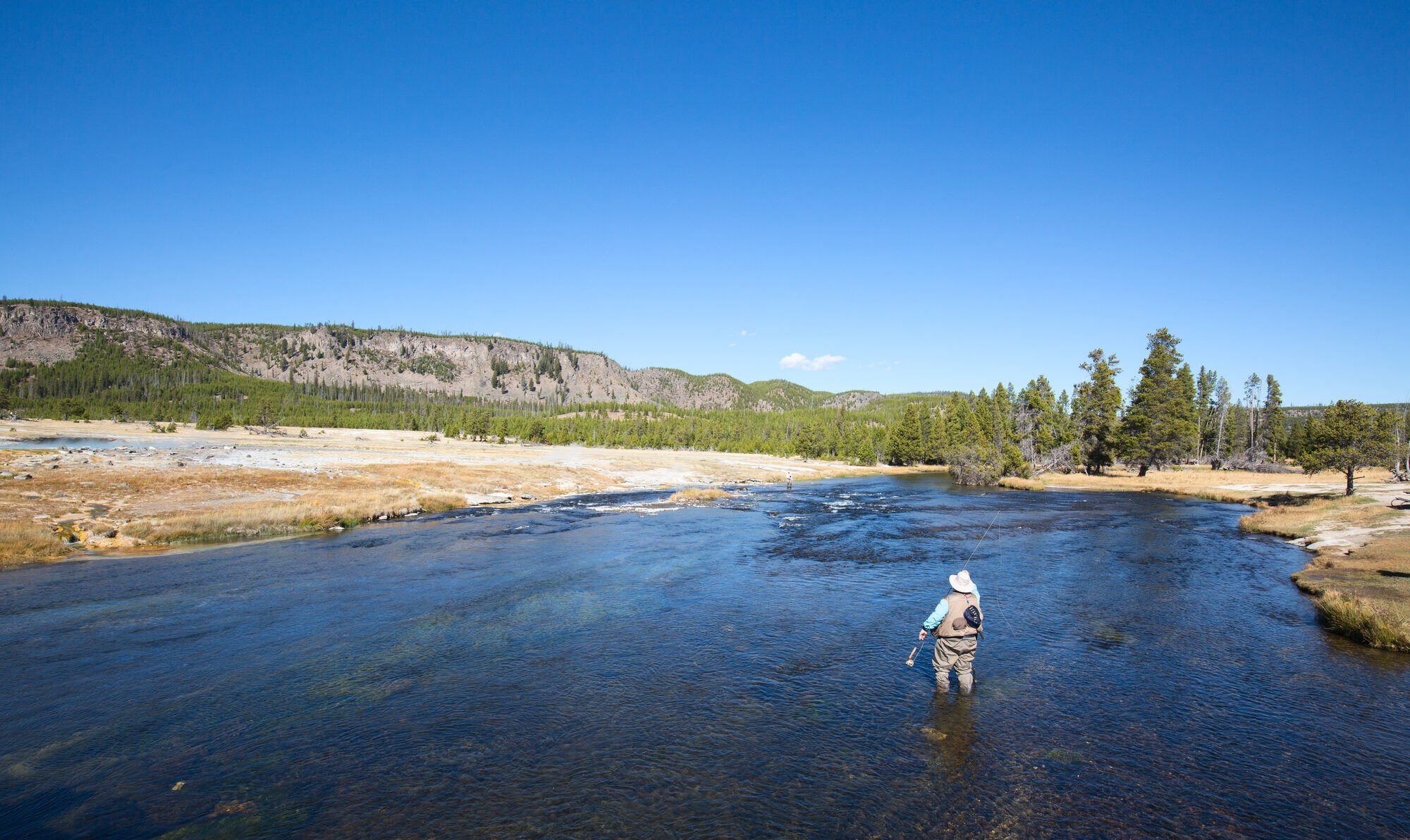
Henry's Fork of the Snake River is a 127-mile trout fishery originating at Big Springs in Island Park, Idaho. The most productive water runs from Last Chance through the Railroad Ranch, with the Salmonfly hatch (mid-June) and Green Drake hatch (late June–early July) as marquee events. Idaho Fish & Game lists trout density on Box Canyon at roughly 3,000 fish per mile.
Why the Henry's Fork is different
Most Western trout rivers have one identity. A freestone river is a freestone river. A tailwater is a tailwater. The Henry’s Fork is unusual because it’s several rivers strung together. Within a single day’s drive you can fish boulder-pocketed pocket water that rewards short casts, spring-creek flatwater that demands long leaders and perfect drifts, classic riffle-and-run dry-fly water, and stillwater connected to a lake. The hatches are world-class. The fish are wild rainbows, browns, and cutthroats, some of which never see a hatchery.
Henry’s Fork Anglers, the shop that has guided this river since 1976, puts it directly:
“The Henry’s Fork is a place where the fish can teach you to be a better angler, where each cast must be carefully considered, and where the river demands attention to detail.” — Henry’s Fork Anglers blog
That sentence is doing real work. The Henry’s Fork — particularly the Harriman / Railroad Ranch water — is famous for refusing average presentations. Fish here see hundreds of bad flies every season. The river is technical in a way most American trout fishing is not, which is precisely why fishing it well feels earned.
The sections, top to bottom
The Henry’s Fork is a long river. From its true headwater at Big Springs to where it meets the Snake below Ashton, it’s about 127 miles. For practical fly-fishing purposes, you’re working five named stretches. Each fishes differently.
Big Springs & the Springs section (no fishing)
The headwater itself is closed to fishing. You can stand on the footbridge over Big Springs and watch enormous wild rainbows lift in the clear water. They are off-limits from Big Springs down to the first major access point. Don’t test this — it’s a marquee enforcement spot for Idaho Fish & Game.
Mack’s Inn down to Coffee Pot Rapids (early-season favorite)
Mellow meadow water, easy wading, good salmonfly action in early June. Best for families, beginners, and the warm-up day before the Box. Not the showcase water, but reliable.
Box Canyon (powerful pocket water)
Below Island Park Dam, the river drops into the Box Canyon — three miles of boulder-strewn, fast pocket water. Cobble-cobble wading; falling in is a meaningful risk. The trade-off is that the rainbows here are some of the strongest in the river, and the salmon fly hatch in early June is iconic.
“The Box, best known for the salmon fly hatch in early June, fishes extremely well early in the season, and the rainbows in this section are some of the strongest fish in the Henry’s Fork.” — Jack Dennis Fishing Trips — Henry’s Fork of the Snake
Last Chance (pre-Ranch warm-up)
Last Chance is the village between Box Canyon and Harriman State Park — both TroutHunter and Henry’s Fork Anglers are here. The river immediately above the Ranch boundary fishes well in early season and is wadeable for most anglers. This is where many people start.
Harriman State Park / The Railroad Ranch (the showcase water)
Eight miles of catch-and-release, fly-fishing-only spring-creek water through the 11,000-acre Harriman State Park. Slow-moving, glassy, weedy. Trout sip mayflies in feeding lanes you have to spot from a distance. This is the most demanding dry-fly water in the United States, with the most famous hatch in American fly fishing — the green drake — emerging here in mid-to-late June. The 6-weight rod handles the wind off the meadows; the 12-foot leader keeps you out of the fish’s feeding lane.
Below the Ranch — Pinehaven to Riverside (forgiving riffles)
Easier wading, forgiving water, plentiful fish. The lower river is the right call when the Ranch has too much wind or too many anglers, and is the right call in late summer when water temperatures push fish to faster, cooler water.
Lower river — below Mesa Falls (different river)
Below Mesa Falls, the Henry’s Fork changes character entirely — warmer, more pastoral, and a different fishery. Outside the scope of most Island Park trips.
When to come: hatches and timing
The Henry’s Fork is not a year-round fishery in any practical sense. The general fishing season opens Memorial Day weekend. Below are the windows that matter, drawn from the published timing pages of Henry’s Fork Anglers and Henry’s Fork Lodge.
Salmon flies (late May – early June)
The first major hatch of the year, primarily in Box Canyon. Big bugs, aggressive eats. The Box fishes extremely well during this window. Be cautious about wading conditions if runoff is still elevated.
Green drake (mid-to-late June – ~2 weeks)
The famous hatch on the Ranch. From The Curious Angler’s account of fishing it:
“The green drake is a big, greenish-yellow mayfly that makes trout throw caution to the wind.” — The Curious Angler
The hatch typically starts around 11 AM and runs an hour or so, longer on cool, overcast days. Best fly patterns are emergers, cripples, spinners, and duns in sizes 10–12.
Brown drake (immediately following green drake)
An evening hatch, usually beginning right as the green drake winds down. Brown drakes appear around 7–8 PM and can produce some of the largest fish of the year.
Caddis & PMDs (July)
July is steady, productive dry-fly fishing. PMDs (pale morning duns) in size 16–18 are the backbone. Hopper-dropper rigs start working in late July.
Tricos & terrestrials (August)
Morning tricos, afternoon hoppers and ants. The crowds are highest now — book guides four to six weeks ahead. Caution: water temperatures below Stone Bridge can climb into the 70s on hot afternoons. Many guides won’t fish certain reaches after noon in mid-August to protect the trout.
Mahogany duns & baetis (September – October)
Cooler water, smaller hatches, aggressive fish preparing for winter. Locals’ favorite season — fewer crowds, brown trout particularly active. The 5-weight returns; flies drop to size 18–20.
Winter (closed)
Most sections are closed November through Memorial Day. Some lower water remains open under specific rules. Check the current Idaho Fish & Game rules at idfg.idaho.gov/rules/fish before planning a winter trip.
Gear
The Henry’s Fork rewards correct gear more than most rivers. Below is the working setup for the main mid-summer Ranch and Last Chance fishing.
Rod
A 9-foot, 5-weight is the classic Henry’s Fork rod for technical dry-fly work. A 9-foot, 6-weight is more forgiving when wind picks up in the afternoon — which it does almost daily on the Ranch. Many local guides recommend the 6 as the primary rod and the 5 for calm mornings.
Leader
Long. Twelve feet minimum on the Ranch, 14 feet preferred for spooky fish. Tippet down to 5X for size 14 flies and 6X for smaller. The fish will refuse a fly with a leader that drags or piles.
Line
Floating, weight-forward, with a long front taper. Some Henry’s Fork anglers prefer a triangle-taper specifically because it delivers a delicate presentation at distance on flat water.
Waders & boots
Stockingfoot waders, felt-soled or rubber-soled studded boots. Felt is faster on slick rocks in the Box Canyon, but is banned in some Western states — not Idaho currently, but verify before you arrive. The Box requires excellent wading. A wading staff is not optional in the Box.
Box
Tie on what’s hatching. The local fly shops — TroutHunter and Henry’s Fork Anglers — will tell you exactly what was working that morning. Walk in and ask. They’d rather sell you the right fly than the most expensive fly.
Other
Stream thermometer (carry it in August). Polarized sunglasses. A net with a long handle for the Ranch. Sun protection. Bear spray if you’re hiking in or walking back to your vehicle at dusk.
Where to find a guide or a fly
If you have never fished the Henry’s Fork, hire a guide for the first day. A half day on the Ranch with someone who knows where the fish hold and what they’re eating compresses what would otherwise be three or four days of self-instruction. After day one, you can fish on your own with materially better odds.
The two canonical shops on the river:
Henry's Fork Anglers
Operating on the Henry's Fork since 1976. The shop most regulars treat as the canonical source for hatch information, guides, and local knowledge. Full-service: rods, flies, guides, and a small lodge on the river.
TroutHunter
On the river in Last Chance, immediately above Harriman. Fly shop, full guide service, grill that serves both lunch and dinner, and modest river-front lodging. The other canonical shop on the Henry's Fork.
Henry's Fork Foundation
Not a shop or guide service — the conservation organization that has worked since 1984 to protect the Henry's Fork watershed. Real-time water-quality data, restoration work, water-policy advocacy. Membership supports the river you came here to fish.
Regulations & licenses
Idaho requires a fishing license for anyone 14 and older. Per Idaho Fish & Game (idfg.idaho.gov/licenses/fees-nonresident):
- Nonresident annual: $108
- Nonresident daily: $22.75 first day, $7 per additional consecutive day
- 3-day salmon & steelhead: $44.75 (not relevant to the Henry’s Fork)
Buy at Go Outdoors Idaho, by phone at 1-800-554-8685, or in person at TroutHunter, Henry’s Fork Anglers, and most general stores in Island Park.
Section-specific rules to know
- Big Springs: Closed to fishing year-round.
- Harriman State Park / Railroad Ranch: Fly-fishing only, catch-and-release, barbless hooks. Eight miles of river. This is a marquee fishery and the rules are enforced.
- Box Canyon: Catch-and-release for rainbow trout. Specific section rules can change year to year — verify in the current Idaho Fish & Game rule book.
- Below Mesa Falls: Different rules entirely. If you’re fishing below the falls, look it up.
Current rules: idfg.idaho.gov/rules/fish. The rule book is updated annually. When in doubt, ask in the shop before stepping in.
Where to stay if you’re fishing
If the river is the trip, two of our cabins put you on the water:
- Riverfront Wildlife Lodge — on the Henry’s Fork at Big Springs. Walk to fishable water from the deck. Six themed bedrooms, sleeps 16+. The trade-off is the section immediately at Big Springs is closed; you’re a short drive from the open water at Mack’s Inn.
- The Lodge at Cutthroat Landing — on Henry’s Lake. Stillwater fishing for cutthroat trout from the property, with a 20-minute drive to the Henry’s Fork at Mack’s Inn.
Browse all seven cabins for capacity and location specifics.
Questions, answered
What’s the single best week on the Henry’s Fork?
The third week of June, almost universally. That’s the peak of the green drake hatch on Harriman, with brown drakes immediately following. Book lodging four to six months ahead for that week.
Can a beginner fish the Henry’s Fork?
Yes — but not by starting on the Ranch. Begin at Last Chance or below Pinehaven, or hire a guide for your first day. The Ranch will frustrate a beginner badly.
Do I need a guide?
Not technically. Practically, yes for the first day. The Henry’s Fork is a river where local knowledge converts to caught fish at a much higher rate than equipment quality.
Can I keep fish?
On Harriman and several other key sections, no — catch-and-release with barbless hooks only. Other sections have varying limits. Read the current rule book before keeping anything.
How crowded is it?
Crowded by Idaho standards in late June through mid-August, especially the Ranch. The lower river and the early-morning Ranch fish are still findable if you’re willing to walk and wade longer.
How does the Henry’s Fork compare to the Madison or the Big Hole?
The Henry’s Fork is more technical — particularly the Ranch — and rewards precise presentations more than the Madison or Big Hole, both of which are more forgiving freestone rivers. The Henry’s Fork hatches are more famous and more reliable. If you’ve fished the Madison and want a step up in technical difficulty, this is the right river.
Sources & further reading
- Henry's Fork Anglers — Why the Henry's Fork is legendary
- Henry's Fork Anglers — Timing
- Henry's Fork Lodge — Fishing Calendar
- The Curious Angler — Fly Fishing the Green Drake Hatch
- Jack Dennis Fishing Trips — Henry's Fork of the Snake
- Lawson's Henry's Fork — Mike Lawson essay
- Idaho Fish & Game — Fishing Rules
- Idaho Fish & Game — Nonresident License Fees
- Henry's Fork Foundation
- TroutHunter
- Washington Fly Fishing Forum — Help on Henry's Fork