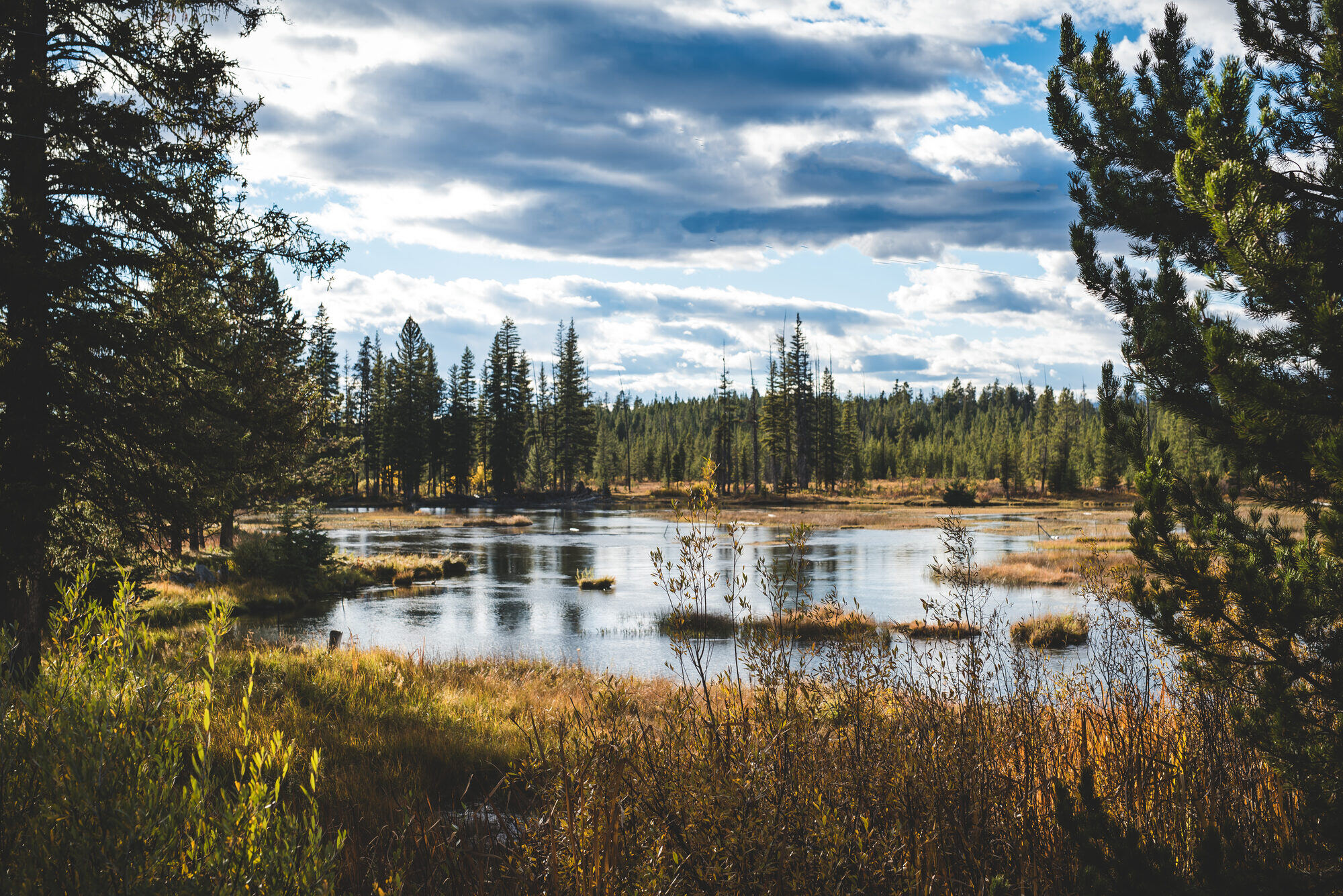
Island Park, Idaho is a high-elevation resort area at 6,300 feet in eastern Idaho, sitting between Yellowstone's west entrance and the Henry's Fork of the Snake River. The town stretches 33 miles along U.S. Highway 20 — the longest Main Street in America. Peak seasons: snowmobiling December through March and fly fishing May through October.
What Island Park actually is
Island Park is a 33-mile-long incorporated city in eastern Idaho, but the place name is misleading on two counts. It is not an island, and the resident population in the 2020 U.S. Census was 193 people — down from 286 in 2010 (Wikipedia). What it actually is, geographically, is a section of the Caribou-Targhee National Forest that sits inside a volcanic caldera, threaded by one of the most famous trout rivers in the United States, twenty-nine miles from the west gate of Yellowstone.
The caldera is the part most people don’t notice. About 1.3 million years ago a Yellowstone-hotspot eruption produced an explosion that distributed roughly 280 cubic kilometers of ash — the Mesa Falls Tuff — across what is now Wyoming, Colorado, Nebraska, and Kansas (USGS / Wikipedia: Henry’s Fork Caldera). What collapsed afterward is the Henry’s Fork Caldera, a smaller sibling of the Yellowstone caldera next door. Wikipedia notes it is “the only large caldera in the Yellowstone region that is plainly visible” — the others are buried under their own subsequent lava flows.
The bowl of the caldera is where Island Park sits. The Henry’s Fork of the Snake River — referred to locally as just “the Henry’s Fork” — meanders through the bowl, with its headwaters at Big Springs and a second source at Henry’s Lake to the north. The river is impounded downstream to form Island Park Reservoir.
“Although much smaller than either the Island Park Caldera or the Yellowstone Caldera, the Henry’s Fork Caldera is still one of the largest calderas in the world.” — Wikipedia: Henry’s Fork Caldera, citing USGS records
The caldera floor is flat and forested. The river is full of trout. Wildlife is dense — moose, elk, sandhill cranes, trumpeter swans, the occasional grizzly. The Yellowstone west entrance is exactly thirty-one minutes away. That combination — wild country, world-class fishing, Yellowstone access — is why Island Park exists as a destination.
Getting here
Most visitors fly into one of two airports: Idaho Falls Regional (IDA), about 85 miles south on US-20, or Bozeman Yellowstone International (BZN), about 100 miles north through West Yellowstone. Idaho Falls is closer, smaller, and easier. Bozeman has more flights and is the right call if you’re also stopping in Big Sky or Yellowstone’s north side.
From either airport, the drive is straight up or down US Highway 20 — a two-lane road most of the way, with mountain passes, scenic stretches, and seasonal road closures in winter. Check 511.idaho.gov for current conditions before heading out from late October through April.
The distance from Island Park to the Yellowstone west entrance is 29 miles, a 31-minute drive. You can be inside Yellowstone before the morning bear-sighting crowd arrives.
Driving in winter
The pass between Ashton and Island Park gets serious snow. Roads are plowed and US-20 stays open year-round except during major storms, but multi-day closures do happen. Carry extra food and water in your vehicle in case of an unexpected hold.
Cell coverage in the area is spotty. Download offline Google Maps tiles for everything north of Ashton before you leave service. National Park Service road status for Yellowstone is at nps.gov/yell/planyourvisit/parkroads.htm.
The Henry's Fork: the river the area is built around
The Henry’s Fork of the Snake River is the reason serious anglers know Island Park’s name. It has been ranked among the top fly-fishing rivers in the United States for decades, with sections in the federally protected Wild & Scenic system.
The river starts in two places. The northern headwater is Henry’s Lake, just below the Continental Divide. The other — and the more spectacular of the two — is Big Springs, where 120 million gallons of water emerge from the ground every day (West Yellowstone Net). Big Springs is a National Natural Landmark and one of the forty largest springs in the world. The water at the source runs at a constant 52 degrees year-round, and the trout you can see swimming in it from the footbridge are off-limits. Fishing is prohibited from Big Springs down to the first major access point.
From the springs, the river runs south through Mack’s Inn, the Box Canyon (a boulder-strewn wading section that is famously productive and famously hard to walk in), Last Chance, and the legendary Harriman State Park section — eight miles of catch-and-release, fly-fishing-only water known as “the Railroad Ranch.” The river then drops over Mesa Falls and joins the Snake River system below Ashton.
What anglers say about it
From an experienced angler on a public fly-fishing forum, describing the variety:
“Sections like Harriman resemble a spring creek, the Box is bouldery and tricky wading but great fishing, and there are fairly easy wading riffly sections on the lower river.” — Washington Fly Fishing Forum, Help on Henry’s Fork thread
The same thread carries a warning that matters in summer: in August, water temperatures below Stone Bridge can climb to a point where catch-and-release is harmful to fish. Locals carry a stream thermometer.
The full breakdown of seasons, sections, and hatches lives in our Henry’s Fork fly-fishing guide. The short version: hire a guide for your first day on the river. The Henry’s Fork rewards local knowledge in a way that almost no other Western trout fishery does.
The Henry's Fork Foundation
Founded in 1984 and based in Ashton, the Henry’s Fork Foundation is the only nonprofit whose sole mission is conserving this watershed. They run real-time water-quality monitoring, fund restoration projects, and work with irrigation districts and hydroelectric companies to keep streamflow healthy. If you spend time fishing here, membership is the right move.
Things to do
Island Park is one of those rare places where the activity menu changes completely with the seasons. In June you fish dry flies. In January you ride snowmobiles across the same country.
Fly fishing the Henry’s Fork (June – October)
The biggest draw. Wadeable sections at Last Chance, Box Canyon, and Riverside Campground; float-only water above and below Harriman. The Harriman / Railroad Ranch water — eight miles of spring-creek-style flatwater — is managed fly-fishing only and is among the most demanding dry-fly water in the country. Bring a 5-weight or 6-weight rod. The 6-weight handles wind better; the 5 is more sensitive for small dries on flat water.
Full breakdown in the Henry’s Fork fly fishing guide.
Float trips on the river (June – August)
The classic Island Park family float is Big Springs to Mack’s Inn — about three hours of slow, cold, crystal-clear water through forest. Tubes can be rented locally. Put-ins, take-outs, and what to bring are in the Henry’s Fork float trip guide.
Yellowstone day trips (May – October)
The west entrance is twenty-nine miles north. From there, the inner loop puts you within an hour of Old Faithful and the Grand Prismatic geyser basin. Lower Geyser Basin and Madison are even closer. See the west entrance day-trip planner for itineraries, fees, and where to fuel up.
Harriman State Park
Beyond the fishing, Harriman is a working historic site — a former private cattle ranch (the “Railroad Ranch”) owned by the Harriman and Guggenheim families, donated to Idaho in 1977 to become the state’s first state park. The park covers an 11,000-acre wildlife refuge with 22 miles of trail for hiking, biking, and horseback riding (Wikipedia: Harriman State Park (Idaho)). Sandhill cranes, trumpeter swans, moose, elk, and the occasional grizzly. Rangers run summer interpretive tours of the historic ranch buildings.
Reservations: 208-558-7368, up to 12 months in advance. Overnight options include rustic yurts and the Ranch Manager’s House.
Big Springs & Johnny Sack’s Cabin
Big Springs is worth the short drive even without an interest in geology. A paved trail leads to the spring overlook, where you can watch enormous rainbow trout (still off-limits to fishing). A short walk from the spring is the Johnny Sack’s Cabin, a hand-built log cabin completed around 1929 by Johnny Sack, a German immigrant carpenter, on a $4.15-per-year land lease (Idaho Heritage Trust). The cabin uses a distinctive split-bark technique on the exterior and contains hand-carved furniture Sack made during the thirty years he lived there. Free, open in summer 10:00 AM – 4:00 PM.
Mesa Falls Scenic Byway
Twenty-eight miles of paved scenic byway connecting Ashton to the Henry’s Fork. The route includes Upper Mesa Falls (114 feet) and Lower Mesa Falls (65 feet) — the last two undammed major waterfalls on the Snake River system (Visit Idaho). Upper Falls has built viewing platforms and an interpretive center at the restored 1915 Big Falls Inn (open seasonally, approximately May 15 – October 1). Lower Falls is viewable from a quarter-mile overlook.
Site hours in summer: 9:30 AM – 5:30 PM daily. Day-use fee: $5 per vehicle, $1 for motorcycles, bicycles, horses, and hikers (Recreation.gov).
Sawtelle Peak
With a couple of hours and a vehicle with reasonable clearance, drive Sawtelle Peak. A well-maintained gravel road climbs 13 miles and 3,440 feet of elevation to a 9,866-foot summit topped with an FAA long-range radar dome (Wikipedia: Sawtell Peak). 360-degree views into Montana, Wyoming, and across the entire Snake River plain. Stay back from the radar facility — it’s federal.
Snowmobiling (December – March)
Island Park is one of the country’s premier snowmobile destinations. The terrain connects via the Continental Divide Snowmobile Trail (CDST) into Wyoming and Montana. Big Springs has a Forest Service warming hut that can hold 200 people, with picnic tables and a wood stove. Trails, rentals, and operators are in the snowmobiling pillar guide.
Other activities
Horseback riding, mountain biking, ATV/UTV riding (the area has hundreds of miles of motorized trail; the ATV/UTV guide covers vehicle-class-specific routes), cross-country skiing (Harriman alone has 33+ miles of groomed Nordic trails), snowshoeing, wildlife photography, and stargazing — the area has very little light pollution.
Hunting
Idaho is a serious hunting state, with seasons for elk, mule deer, moose, antelope, and waterfowl. Tags often require a controlled-hunt draw application — apply in spring for fall hunts. Specific units, dates, and tag rules are at Idaho Fish & Game. A guided hunt through a licensed outfitter is the right answer for hunters new to the area.
Where to stay
Lodging in Island Park ranges from RV parks and rustic motels along US-20 to private vacation cabins in the forest. The cabins are what the area is known for — they let you walk out the back door to the river, the trail, or the snowmobile loop without leaving your property.
Grandview manages seven private cabins in Island Park and Ashton, sized for groups from thirteen to sixty-eight. Some sit on the Henry’s Fork directly. Some look at the Tetons from the deck. All are locally managed and independently owned:
- Riverfront Wildlife Lodge — six themed bedrooms, on the Henry’s Fork, with a private wildlife experience featuring more than 40 animals on the property.
- The Lodge at Cutthroat Landing — hotel-grade finish on Henry’s Lake.
- Teton View Retreat (Both) — twin-dome compound, sleeps 68 under one roof.
- Teton View Retreat — East and West — bookable independently.
- Trails End Lodge — the cabin trip without the cabin price.
- Beautiful Views — fifteen minutes from Yellowstone, the shortest drive in the collection.
- The Treehouse — a new-build cabin on two-plus wooded acres, five bedrooms, sleeps 14, thirty minutes from the west entrance.
Browse the full collection for capacity, photos, and pricing on all six.
Where to eat
Island Park is a small town — the year-round resident count is under 200 — so the restaurant scene is concentrated along US-20 between Mack’s Inn and Pond’s Lodge. Most spots are seasonal or have reduced winter hours. Reservations are smart in summer.
Pond's Lodge
The lodge restaurant with a 70+ year history on US-20. Their main kitchen serves a full menu (closed Tuesdays); the pizza kitchen is open seven days. Reservations recommended — the dining room is small, and lodging and guiding guests get priority.
The Parlor at Mack's Inn
Wood-fired pizza, ice cream, coffee, and casual dishes in the Mack's Inn complex at the north end of Island Park. A reliable family stop, especially for evenings after a float on the river.
TroutHunter
Both an outfitter and a restaurant. On the river in Last Chance, with a grill that locals use for both lunch and dinner. The fly shop is one of the canonical Henry's Fork shops, alongside Henry's Fork Anglers.
Practical information
Yellowstone entrance fees (2026)
Per the National Park Service (nps.gov/yell/planyourvisit/fees.htm):
- 7-day Yellowstone vehicle pass: $35
- Yellowstone Annual Pass: $70 (Yellowstone-only)
- America the Beautiful Annual Pass: $80 (covers all national parks)
- Nonresident surcharge (begins 2026): $100 per non-US visitor age 16+, in addition to the entrance fee, unless using an Annual Pass
Buy at the gate or in advance through Recreation.gov.
Idaho fishing licenses (2026)
Per Idaho Fish & Game (idfg.idaho.gov/licenses/fees-nonresident):
- Nonresident annual fishing: $108
- Nonresident daily fishing: $22.75 first day, $7 per additional consecutive day
- 3-day salmon and steelhead: $44.75
Buy online at Go Outdoors Idaho, by phone at 1-800-554-8685, or at any of the local vendors (TroutHunter, Henry’s Fork Anglers, and most general stores in Island Park sell licenses).
Services & cell coverage
Cell coverage along US-20 is reasonable but disappears within a few miles in any direction. Download offline maps before leaving Idaho Falls. There’s a Subway at 4141 Sawtelle Peak Road and limited groceries at the lodges. For a real grocery run, drive to Broulim’s in St. Anthony (about 33 miles south).
Wildlife awareness
Grizzly bears, black bears, and moose are all present. Carry bear spray on any hike off the road. Don’t leave food, coolers, or trash in your vehicle or on a deck overnight. Moose are responsible for more injuries in this part of Idaho than bears — give them space.
When to visit
Each season is a different trip.
Spring (April – mid-June)
Mud season. Yellowstone roads begin opening in late April. River fishing is slow until June. The trade-off: this is when newborn elk and moose calves appear, and it’s the quietest time of year. Best for travelers who want low crowds and don’t need a specific activity.
Summer (mid-June – early September)
Peak season. Fishing is at its best from late June through August, with the famous green drake hatch on the Henry’s Fork in June and a wave of caddis and PMD hatches into August. Family vacationers, fly fishers, and Yellowstone-bound road trippers all overlap. Book lodging four to six months out.
Fall (September – October)
Many locals’ favorite season. Aspens turn gold, the elk rut is at full volume in Yellowstone, fishing improves through October as water cools, and the summer crowds thin out. Hunting seasons begin. Controlled-hunt tag draws are decided in advance, but general-season tags for elk and deer are available across multiple units.
Winter (December – March)
Snowmobile country. Yellowstone is partially open for guided snowmobile and snowcoach tours from the west entrance. Harriman’s 33+ miles of groomed Nordic trails are world-class. Sub-zero nights are common, and US-20 may close briefly during storms. Pack for serious cold.
Questions, answered
Is Island Park actually an island?
No. It’s a 33-mile-long strip of land — by area, one of the longest “main streets” of any incorporated town in the United States — that sits inside the Henry’s Fork Caldera.
How far is Island Park from Yellowstone?
29 miles to the west entrance, about 31 minutes by car.
Do I need a fishing license to fish here?
Yes. Idaho requires a license for anyone 14 and older fishing in state waters. A nonresident annual license is $108; a daily is $22.75. Big Springs is closed to fishing — watch the trout, but don’t cast.
What’s the best month to fish the Henry’s Fork?
Late June is the green drake hatch, widely considered the peak event on the river. July and August bring caddis, PMDs, and hoppers. September brings cooler water and aggressive pre-spawn fish. Avoid wading the lower river in August afternoons — water can warm to a point where catch-and-release is harmful.
Are there grizzlies?
Yes, especially on the eastern side of Island Park near the Yellowstone boundary. Carry bear spray on hikes, store food properly, and make noise on the trail.
What’s the best month to snowmobile?
January through early March. The Continental Divide Snowmobile Trail and the connected Two Top trail system are reliably groomed and have deep snowpack through this window.
Where are the closest grocery stores?
Limited convenience-store and lodge groceries are available in Island Park. For a full grocery run, drive to Broulim’s in St. Anthony (33 miles south on US-20), or stock up in Rexburg or Idaho Falls before driving up.
Sources & further reading
- Wikipedia — Island Park, Idaho
- Wikipedia — Henry's Fork Caldera
- Wikipedia — Harriman State Park (Idaho)
- Wikipedia — Sawtell Peak
- USGS Yellowstone Volcano Observatory
- NPS — Yellowstone Fees & Passes
- Idaho Fish & Game — Nonresident license fees
- Idaho Parks & Recreation — Harriman State Park
- Visit Idaho — Mesa Falls Scenic Byway
- Recreation.gov — Mesa Falls
- Idaho Heritage Trust — Johnny Sack Cabin
- Henry's Fork Foundation
- USFS Caribou-Targhee National Forest
- Pond's Lodge — official menu and hours
- TroutHunter — official site